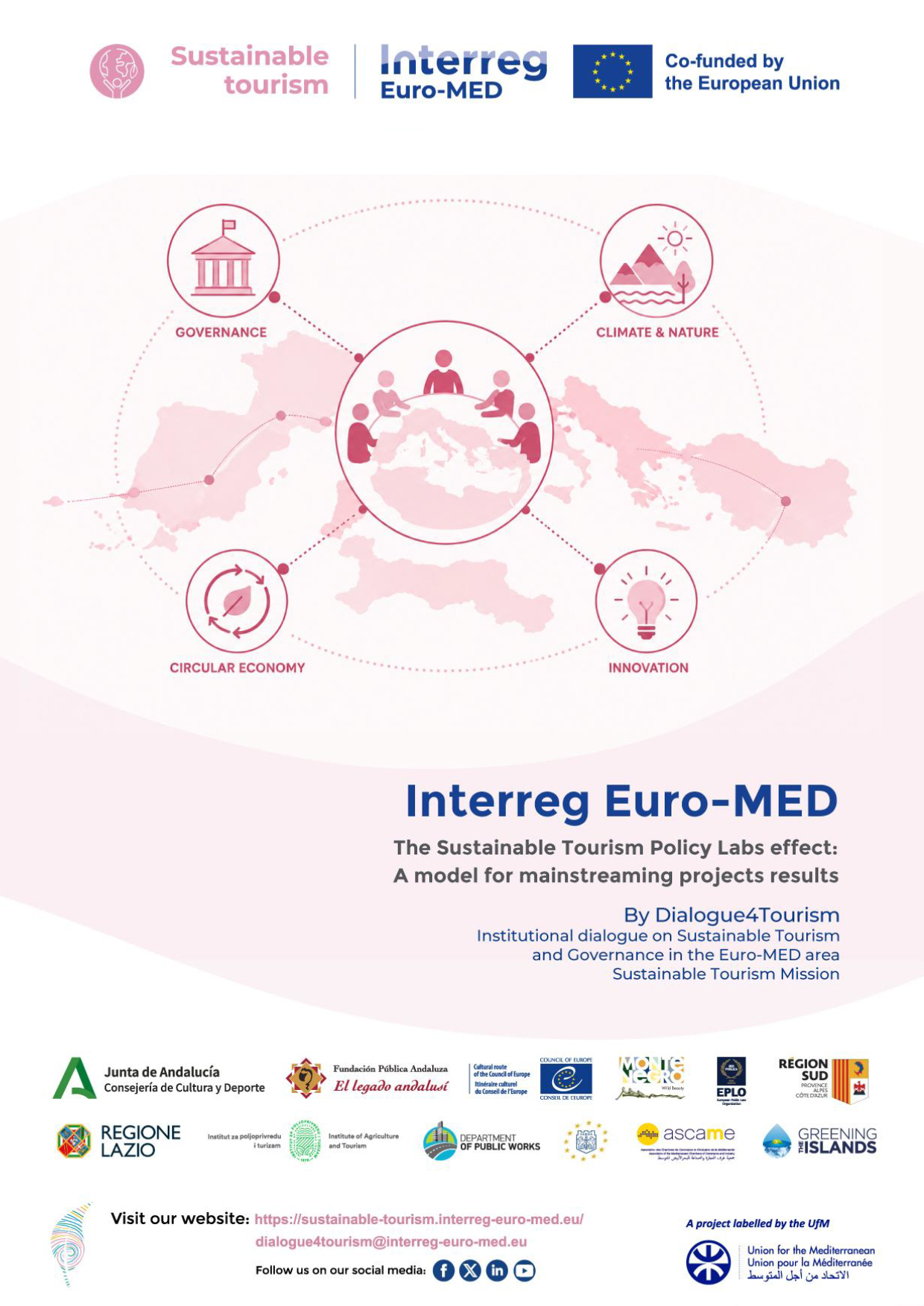

How can we turn the results and tools developed in European projects into real, lasting public policies? To answer this question, the Dialogue4Tourism project has launched a report based on its Sustainable Tourism Policy Labs (STPLs). This document shows how the results of Interreg Euro-MED thematic projects—such as HERIT ADAPT, Cool Noons, MED-Routes, SMITour, TOURISMO, ECO-SEAROUTES, LIBECCIO or MedSkyTour—can actually make the leap from theory to local and regional governance. Through sessions of the Sustainable Tourism Policy Labs held in Greece, Bulgaria, Cyprus, and Montenegro, the report explores hands-on solutions for Mediterranean issues like overtourism, climate impacts and the circular economy transition.
Recommendations for transfer and replication
Looking closely at the lessons learned during these labs, the report points out that transferring policies effectively takes more than just sharing technical data. It stresses the importance of sending concise destination profiles to participants beforehand so everyone starts on the same page. It also reminds us that technical solutions, indicators, or smart tools only work if they go hand in hand with strong institutional capacity and political backing. On top of that, organizers should focus on a few well-targeted, high-quality project examples instead of overloading participants with broad summaries, while always dedicate time for collective reflection and informal networking.
Main conclusions
At its heart, the report leaves us with one idea: good governance and cross-border cooperation are the real backbone of sustainable tourism. Circular economy tools, smart monitoring, or climate adaptation measures are only as good as the political and institutional frameworks behind them. Ultimately, the Sustainable Tourism Policy Labs approach proves that there are no one-size-fits-all formulas; what works is having a structured yet flexible process capable of adapting and tailoring innovative solutions to the unique reality of each Mediterranean destination.