
Our Thematic Projects Eco-Sea Routes and TOURISMO showcase their pilot experiences in Cyprus as models of governance for sustainable island tourism in this Lab
The Sustainable Tourism Policy Lab organised organised by the Interreg Euro-MED Dialogue4Tourism Project throught the partner Ministry of Transport, Communication and Works of Cyprus online today under the auspices of the Cyprus Presidency of the Council of the European Union brought together policymakers, experts and project partners to advance coordination and innovation in sustainable tourism governance. The event focused on strengthening institutional capacity, promoting policy transformation, and capitalising on results generated by thematic projects.
Institutional welcome and political backing
The event opened with welcome addresses from key institutional representatives of Cyprus and the Interreg Euro-MED Programme. Alexis Vafeades, Minister of Transport, Communications and Works of the Republic of Cyprus, highlighted the strategic importance of sustainable tourism for island territories and the need to balance economic growth with environmental protection. He was followed by Marilena Ayiomamitou, Growth Officer at the Directorate General for Growth of the Ministry of Finance and National Contact Point for the Interreg Euro-MED Programme, who stressed the importance of transnational cooperation and the role of European programmes in strengthening institutional capacity across the Mediterranean.
Closing this opening session, Curzio Cervelli, Coordinator of the Interreg Euro-MED Joint Secretariat, emphasised the importance of the Programme’s architecture and governance dimension. He highlighted that the work carried out by the governance projects of the Interreg Euro-MED Sustainable Tourism Mission —Dialogue4Tourism and Community4Tourism—alongside initiatives such as the Sustainable Tourism Policy Labs, represents “a good example for the future of governance projects.” Cervelli also underlined that this approach aligns with the European Commission’s new direction on tourism, including the upcoming open call and a specific strategy for islands. “The priority is to capture the best results of the Thematic Projects of the Mission, ensuring coordination between the two governance projects, in order to export these outcomes beyond the Programme,” he stated. He also announced the launch of a new call of the Mediterranean MultiProgramme Mechanism.
Agenda highlights
The session combined institutional introductions with a presentation of the Policy Lab methodology and a practical working phase focused on the main challenges affecting Mediterranean islands. Participants engaged in interactive discussions on governance, innovation and circular economy, applying these concepts to the case of Cyprus. The programme also featured the presentation of the Eco-Sea Routes pilot experience in Cyprus, alongside other project examples, before concluding with a collective reflection on the outcomes and policy implications.
A laboratory for policy innovation
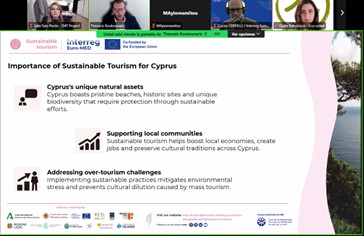
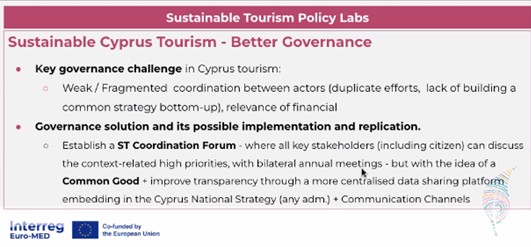
The Sustainable Tourism Policy Labs are designed as interactive spaces to bridge theory and practice. By applying shared methodologies and analysing real case studies—such as Cyprus as an island destination—participants co-designed solutions to improve governance, foster circular economy practices, and support socio-economic development.
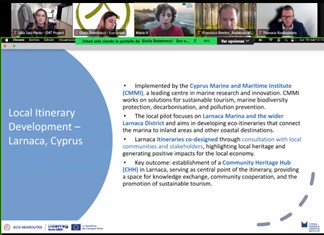
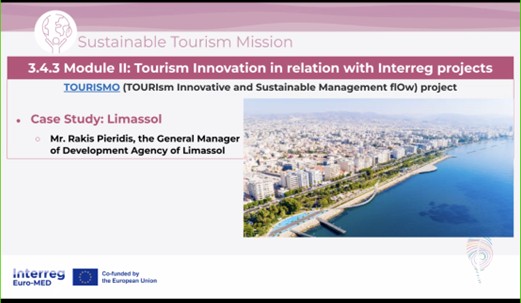
A key moment of the event was the contribution of the Eco-Sea Routes and TOURISMO Projects, whose pilot experience in Cyprus illustrated how thematic projects can deliver concrete and transferable solutions. The Eco-Sea Routes focuses on sustainable maritime routes and cultural heritage interpretation provided a tangible example of how innovation can be integrated into policy-making for island tourism. This Lab is part of a broader series of Policy Labs taking place across the Mediterranean in 2026, reinforcing cooperation and knowledge exchange among stakeholders.