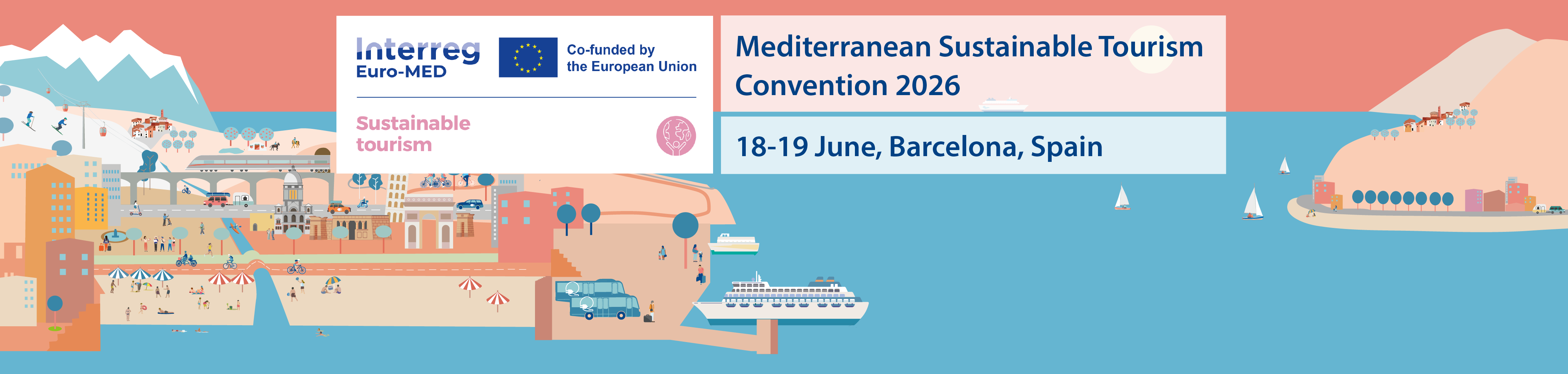
The MED Sustainable Tourism Convention 2026
The MED Sustainable Tourism Convention 2026, organised by the Barcelona Provincial Council in collaboration with the Community4Tourism partnership in the framework of the Mediterranean Sustainable Tourism Community, took place in Barcelona on 18–19 June 2026.
Under the theme “Tourism transition in the Mediterranean”, the third edition of the Convention wanted to foster a strategic debate on new tourism agendas, climate change, resource management, digitalisation, circular and regenerative economy approaches, as well as the role of Mediterranean cooperation in the transition towards more sustainable, resilient and inclusive tourism models. The Convention also provided a platform to showcase the solutions and knowledge generated by the projects of the Mediterranean Sustainable Tourism Community.
The event was hosted by the Barcelona Centre of Contemporary Culture and brought together around 250 tourism stakeholders, including policy-makers, public authorities, experts, researchers and key actors from the Mediterranean tourism ecosystem.
Agenda
Overview
The MED Sustainable Tourism Convention will take place on June 18th and 19th, 2026. While on the first day all the sessions and panels will be held in plenary, on the second day the agenda foresees parallel sessions.
VENUE | Barcelona Centre of Contemporary Culture – Montalegre, 5 – 08001 Barcelona
Side event: On June 17th it will be held instead the side event: Advancing Sustainable Blue Tourism in the Mediterranean: Towards the MED Blue Tourism Flagship Initiative.
Organised in the framework of the MED Sustainable Tourism Convention 2026 and #EUGreenWeek by IUCN Med, IDDRI, eco-union, Plan Bleu, UNEP/MAP and Barcelona Provincial Council.
Participation is limited to registered attendees.
Register here: https://forms.gle/
mkp7hxVmzgJCqeJCA VENUE | Auditorio del Patí Manning, Barcelona
Side event - June 17th, 2026
When: 17 June 2026 | 17:30–19:00 CEST
Where: Auditorio del Patí Manning, Barcelona
This session will bring together Mediterranean stakeholders to share experiences and lessons learned from the Blue Tourism Initiative, and discuss how to scale up sustainable and nature-positive tourism across the region.
The discussion will also look ahead to the Mediterranean Blue Tourism Flagship Initiative under the Barcelona Convention, exploring opportunities for regional cooperation, governance and long-term impact.
REGISTER HERE: https://forms.gle/mkp7hxVmzgJCqeJCA
In-person event only – participation is limited to registered attendees.
Organised in the framework of the MED Sustainable Tourism Convention 2026 and #EUGreenWeek by IUCN Med, IDDRI, eco-union, Plan Bleu, UNEP/MAP and Barcelona Provincial Council.
Thursday, June 18th, 2026
| 09:00 – 09:30 |
Welcome and Registration Master of Ceremony: Ms Ivana Miño |
| 09:30 – 10:00 |
Opening Session
|
| 10:00 – 10:30 |
Policy Opening Session: The new EU Sustainable Tourism StrategyTourism policy is entering a new phase shaped by the European Green Deal, the digital transition and the growing need for resilience and competitiveness. At EU and destination level, new strategic agendas are redefining priorities, governance frameworks and instruments to guide the transformation of the tourism sector. This session will present and discuss the emerging policy agendas for tourism, with a particular focus on European strategies and their implications for Mediterranean destinations. It will explore how these new agendas translate into concrete directions for public authorities, destinations and tourism stakeholders, and how they can support a more sustainable, innovative and resilient tourism model.
|
| 10:30 – 11:00 |
Key-note speech: Tourism transition in the MediterraneanThe Mediterranean is at a critical crossroad in the transformation of tourism models. Climate change, resource pressure, social tensions and shifting demand patterns are challenging destinations to rethink tourism beyond growth-driven paradigms. At the same time, the region concentrates a unique diversity of natural, cultural and social assets that can support a fair and resilient transition. This keynote speech will provide a strategic overview of the tourism transition in the Mediterranean, framing current challenges and emerging opportunities within broader European and global policy agendas. It will set the conceptual foundations for the Convention, highlighting the need for systemic change, multi-level governance and place-based approaches to steer tourism towards sustainability, resilience and social balance.
|
| 11:00 – 11:30 | Coffee-break |
| 11:30 – 12:15 |
Quo Vadis tourism?Tourism is undergoing profound transformations driven by climate emergency, geopolitical instability, technological change and evolving societal expectations. Traditional tourism models are increasingly questioned, while destinations face growing pressure to reconcile competitiveness with environmental and social limits. This session will open a forward-looking dialogue on the future of tourism, exploring where the sector is heading and what choices lie ahead for Mediterranean destinations. Through a strategic conversation, it will reflect on the values, priorities and governance models that should guide tourism development in the coming decades.
A conversation moderated by the General Director at European Tourism Association (ETOA) Mr Tim Fairhurst
|
| 12:15 – 13:00 |
The role of the Mediterranean cooperationThe Mediterranean region shares common challenges that transcend administrative and national borders, from climate risks to mobility, water management and territorial cohesion. In this context, cooperation frameworks play a crucial role in fostering shared learning, coordinated action and policy innovation. This session will examine how Mediterranean cooperation initiatives, networks and programmes contribute to advancing the sustainable tourism transition. It will highlight the added value of transnational collaboration in scaling solutions, aligning policies and reinforcing collective responses to common challenges.
Moderator: Mr Vincent Ernoux, Coordinator of the Interreg NEXT MED Programme for the Western Mediterranean |
| 13:00 – 14:30 | Lunch |
|
TOURISM AND CLIMATE EMERGENCY |
|
| 14:30 – 15:00 |
The Glasgow Declaration: state-of-the-artThe Glasgow Declaration on Climate Action in Tourism represents a global commitment to accelerate climate action across the tourism sector. However, translating pledges into effective implementation remains a key challenge, particularly at destination level. This session will provide an update on the state of play of the Glasgow Declaration, focusing on progress achieved so far, implementation gaps and lessons learned. It will reflect on how Mediterranean destinations and tourism stakeholders are aligning climate strategies with operational realities, governance and long-term objectives.
Moderator: Ms Adriana Tramullas, Project Manager, Network of European Regions for Competitive and Sustainable Tourism (NECSTouR) |
| 15:00 – 15:15 |
Presentation of the Thematic paper “Climate resilience in coastal tourism destinations: solutions from nature and cultural heritage”
|
| 15:15 – 16:00 |
Tourism and climate change; from theory to actionWhile climate commitments and strategies are increasingly present in tourism policies, the transition from planning to concrete action remains uneven. Destinations need practical solutions that can be implemented, monitored and adapted over time. This session will showcase concrete initiatives and projects that move from theory to action, illustrating how climate mitigation and adaptation measures are being applied in tourism contexts. It will focus on transferable solutions, governance mechanisms and the role of innovation in accelerating climate action on the ground.
Moderator: Ms Veronique Evers, Program officer, Priority Action Program / Regional Activity Center for Coastal Management towards sustainability and resilience of Mediterranean coasts |
| 16:00 – 16:45 |
Call for projects (restricted call to MMM programmes) Facilitator: Ms Karina Behar, European Projects Officer, Barcelona Provincial Council – Tourism Department The Mediterranean Multi-Programme Mechanism (MMM) and Mediterranean Pear Learning Visits (MPLV)
Bee-Based Experiences for Sustainable Rural Tourism (MedBEESinessHubs and PLANBEE)
Connecting Ports Through Maritime Heritage and Sustainable Tourism (ADRIJOROUTES)
Creating Dementia-Inclusive Travel Experiences (ADRINCLUSIVE)
Digital Paths for Sustainable Archaeological Tourism (ARCHAEODIGIT)
|
| 17:00 – 18:30 | Natour4CChange Interactive exhibition and networking cocktail |
Friday, June 19th, 2026
From 10:15 to 13:45 the agenda foreseens 2 parallel sessions on different thematic focus
- Focus on Protection and Value of Tourism Resources | Sala TEATRE
- Focus on Stakeholders’ Engagement and Innovation | Sala RAVAL
|
Plenary session | Sala TEATRE |
|
| 09:00 – 09:30 | Registration |
| 09:30 – 10:00 |
Institutional session
The Spanish 2030 Tourism Strategy
|
|
Parallel session | Protection and Value of Tourism Resources | Sala TEATRE |
|
| 10:15 – 10:30 |
Facilitator: Dora Papatheochari, University of Thessaly Presentation of the Thematic paper “Beyond projects: institutionalizing biodiversity and sustainable tourism practices in the Mediterranean”
|
| 10:30 – 11:30 |
Beyond sustainability: regeneration and biodiversitySustainability has become widely adopted in tourism, yet its implementation often focuses on minimizing negative impacts rather than generating positive change. Regenerative tourism proposes a paradigm shift towards actively restoring ecosystems and strengthening local communities. This session explores the concept of regenerative tourism and its practical implications for destinations. It will present experiences that go beyond sustainability, focusing on how tourism can contribute to ecological restoration, social cohesion and long-term territorial resilience.
Moderator: Mr Arnau Bosch, Destinations Sustainable Tourism expert, D’Aleph |
| 11:30 – 12:00 | Coffee-break |
| 12:00 – 13:00 |
Facilitator: Matilda Naço, University of Tirana Heritage and diversified tourism productsThe Mediterranean’s cultural heritage, natural landscapes and local traditions are core assets of its tourism identity. However, these resources are increasingly vulnerable to degradation and climate impacts. This session will focus on strategies to protect, manage and valorise cultural, natural and local resources in a sustainable way. It will examine how tourism can support heritage conservation, reinforce local value chains and contribute to place-based development while preserving authenticity.
Moderator: Ms Julie Wilson, Dean for Research; Associate Professor, Faculty of Economics & Business, Universitat Oberta de Catalunya |
| 13:00 – 13:45 |
Water scarcity and tourismWater scarcity is one of the most critical and structural challenges facing Mediterranean destinations, intensified by climate change and seasonal tourism pressure. Ensuring water security while maintaining tourism activity requires new approaches to improve the management, efficiency and governance. This session will address the nexus between water and tourism, exploring strategies to reduce consumption, improve efficiency and promote integrated water governance. It will highlight innovative practices and collaborative approaches that support sustainable water use in tourism-dependent territories.
Moderator: Mr Fernando Nardi, Professor of Hydrology and Hydraulic Engineering, University of Rome Tor Vergata |
|
Parallel session | Stakeholders’ Engagement and Innovation | Sala RAVAL |
|
| 10:15 – 10:30 |
Facilitator: Emilia Stoduto, UNIMED – Mediterranean Universities Union Presentation of the Thematic paper “Supporting Tourism Micro-enterprises and SMEs in their transition to circular economy practices”
|
| 10:30 – 11:30 |
Circular economy transitionThe tourism sector is a major consumer of resources and generator of waste, making the transition to circular economy models a strategic priority. This transition is particularly challenging for SMEs and micro-enterprises, which dominate the tourism ecosystem. This session will address how circular economy principles can be effectively integrated into tourism value chain. It will present tools, business models and support mechanisms that help tourism stakeholders reduce resource use, close material loops, enhance resilience and competitiveness.
Moderator: Mr Pau Pitarch, Tourism and sustainable development expert, cofounder partner of PAX Tourism Advisors |
| 11:30 – 12:00 | Coffee-break |
| 12:00 – 12:15 |
Facilitator: Andrea Di Girolamo, Adriatic Ionian Euroregion Presentation of the Thematic paper “Smart and data-driven destination management for sustainable tourism in the Mediterranean”
|
| 12:15 – 13:00 |
Smart and data-driven tourism managementManaging tourism flows has become a key concern for destinations facing congestion, overtourism or uneven spatial and temporal distribution of visitors. Data and digital tools offer new opportunities to improve decision-making and policy design. This session will explore how data management and smart destination tools can support more balanced and sustainable tourism flows. It will address challenges related to data availability, governance and capacity-building, highlighting practical applications for destination management.
Moderator: Ms Sandra Navarro, Associate Lecturer, University of Alicante. Destination Management and Planning Consultant |
| 13:00 – 13:45 |
Tourism as the leading sector of the Blue EconomyTourism is deeply interconnected with the blue economy in the Mediterranean, particularly in coastal and maritime areas. While tourism can generate significant economic benefits, it also poses risks to marine ecosystems and coastal communities. This session will examine the role of tourism within the blue economy framework, focusing on sustainable coastal and maritime tourism practices. It will highlight initiatives that promote ecosystem protection, innovation and synergies between tourism and other blue economy sectors.
Moderator: Ms Marta Raspall, Director of Institutional Relations at beon. Worldwide |
| Plenary session | Sala TEATRE | |
| 13:45 – 14:00 |
Closing sessionThe closing plenary will bring together the main insights, lessons learned and policy messages emerging from the Convention. It will provide a synthesis of discussions across sessions, reinforcing shared priorities and future directions. This final session will underline the importance of continued cooperation, action-oriented approaches and long-term commitment to steer the tourism transition in the Mediterranean towards a more sustainable, resilient and inclusive future.
|
| 14:00 – 15:30 | Lunch |
Resources
Event REPORT
Here you can download a REPORT of the event’s sessions
Sessions Recordings
At this link you can find a Youtube playlist listing all the sessions recordings
Speakers Presentations
18 June 2026
Opening Session
Policy Opening Session: The new EU Sustainable Tourism Strategy
Key-note speech: Tourism transition in the Mediterranean
The Glasgow Declaration: state-of-the-art
Presentation of the Thematic paper “Climate resilience in coastal tourism destinations: solutions from nature and cultural heritage”
Tourism and climate change; from theory to action
Call for projects (restricted call to MMM programmes)
- The Mediterranean Multi-Programme Mechanism (MMM) and Mediterranean Pear Learning Visits (MPLV) – Pascale Faveau, Project Officer Interreg MED Joint Secretariat
- Bee-Based Experiences for Sustainable Rural Tourism (MedBEESinessHubs and PLANBEE)
- Creating Dementia-Inclusive Travel Experiences (ADRINCLUSIVE)
- Digital Paths for Sustainable Archaeological Tourism (ARCHAEODIGIT)
Natour4CChange Interactive exhibition
19 June 2026
Presentation of the Thematic paper “Beyond projects: institutionalizing biodiversity and sustainable tourism practices in the Mediterranean”
Heritage and diversified tourism products
Presentation of the Thematic paper “Supporting Tourism Micro-enterprises and SMEs in their transition to circular economy practices”
Circular economy transition
- Alessandro Miraglia, LooP Zone project representative
- Guido Capanna Piscè and Gian Andrea Garancini, MAST project representatives
- Julia Bonello, RECIRCLE MED project representative
- Boris Golob, GreenSET project representative
Presentation of the Thematic paper “Smart and data-driven destination management for sustainable tourism in the Mediterranean”
Thematic Papers
- Smart and Data-Driven Destination Management for Sustainable Tourism in the Mediterranean presented by Tanja Armenski, External expert. Senior Data and Public-Sector Analyst, Evidence-Based Policymaking, Statistical Modelling & Data Governance
- Supporting Tourism Micro-enterprises and SMEs in their Transition to Circular Economy Practices presented by David Mora, Strategic consultant in the tourism sector, partner of Verne Tourism Experts
- Climate resilience in tourism coastal destinations: solutions from Nature and Cultural Heritage presented by Marianne Lang, Consultant & Project Manager-Environment, Sustainable Development & International Cooperation
- Beyond Projects: Institutionalizing Biodiversity and Sustainable Tourism Practices in the Mediterranean presented by Mark Mansoldo, Ecostack Innovations consultant
Photo gallery
Here you can find a photo gallery of the MED Sustainable Tourism Convention 2026