
Interreg Euro-MED Sustainable Tourism Mission showcased tools, lessons learned, and cross-project knowledge to foster transfer across the MED
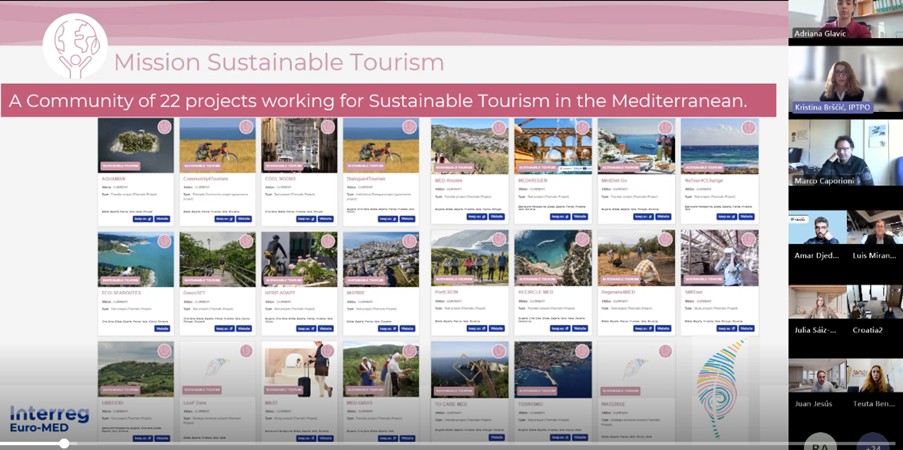
On 10th December 2025, the Sustainable Tourism Mission of the Interreg Euro-MED Programme hosted a Digital Awareness Event aimed at strengthening governance and promoting the transfer of best practices of the Thematic Projects. With the coordination of the Institute of Agriculture and Tourism (Poreč, Croatia) and El legado andalusí Andalusian Public Foundation (Regional Ministry of Culture and Sport of Andalusia, Granada, Spain), the online session brought together partners of the Thematic Projects, stakeholders, and associated actors to reflect on achievements and explore ways to replicate successful experiences across the Mediterranean.
The event followed the 3rd Joint Annual Forum of the Mission and served as a platform to share knowledge, tools, and practices developed within Thematic Projects, ensuring their effective transfer and capitalization to strengthen governance at regional and local levels. It emphasized the Mission’s commitment to a circular tourism model, integrating ecosystem sustainability, innovative technologies, and the preservation of natural and cultural heritage.
El legado andalusí Andalusian Public Foundation, LP of Dialogue4Tourism Project, opened the event, followed by a welcome address from Axel Rodríguez-Garrote, Project Officer at the Interreg Euro-MED Programme attached to the Sustainable Tourism Mission. He remarked that the governance projects have played a crucial role in supporting thematic tourism initiatives and transferring their results to promote a greener Mediterranean transition. He said that 2026 will be a key year when many projects will deliver significant outcomes. He urged attendees to actively reflect on how these insights could be applied in their territories to enhance sustainability. He concluded by emphasizing the importance of engagement and practical use of the projects’ achievements.
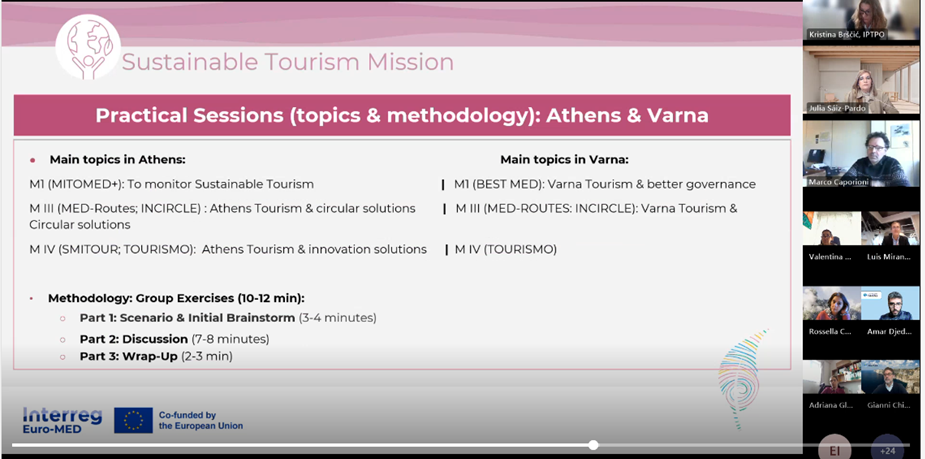
Kristina Brščić from the Institute of Agriculture and Tourism presented the Action Plan for Policy-Driven Reuse and Transferring by Dialogue4Tourism Project, highlighting strategies to systematically transfer knowledge and tools generated by the Mission’s projects to other territories and governance levels.
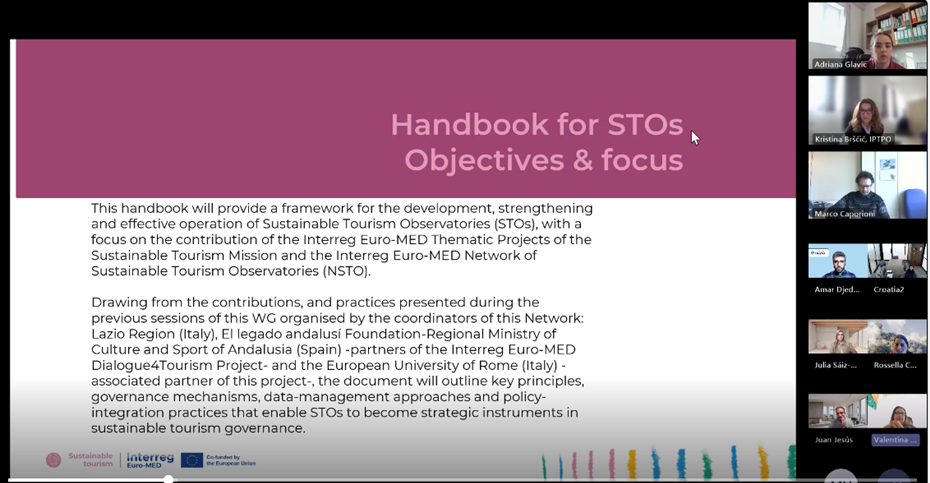
Valentina Castello from the Universitá Europea di Roma shared practical examples of observatory models and demonstrated how these tools can be adapted and replicated to guide sustainable tourism policymaking across different contexts in the frame of the Interreg Euro-MED Network of Sustainable Tourism Observatories. In this sense, she presented the advance of the Handbook for STOs with the support of the MED Cluster of Innovation of Community4Tourism Project. This handbook will provide a framework for the development, strengthening and effective operation of Sustainable Tourism Observatories (STOs), with a focus on the contribution of the Interreg Euro-MED Thematic Projects of the Sustainable Tourism Mission and the Interreg Euro-MED Network of Sustainable Tourism Observatories (NSTO).
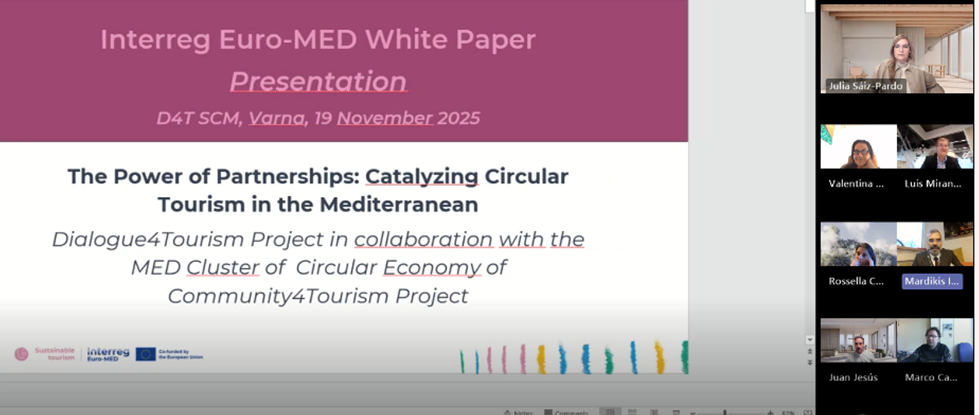
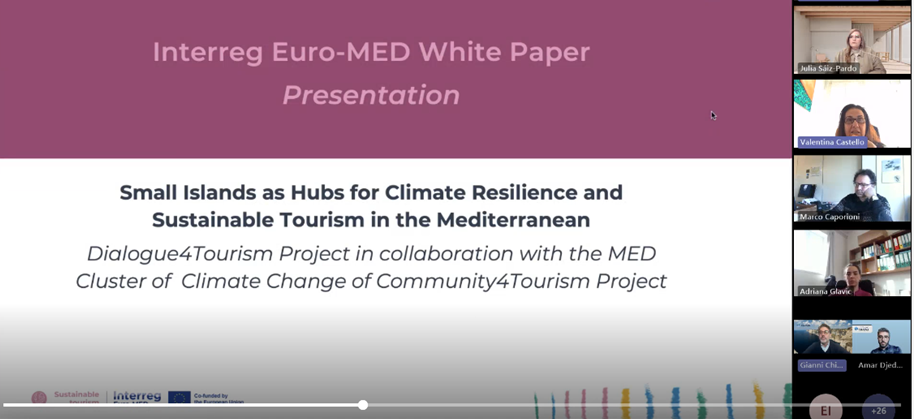
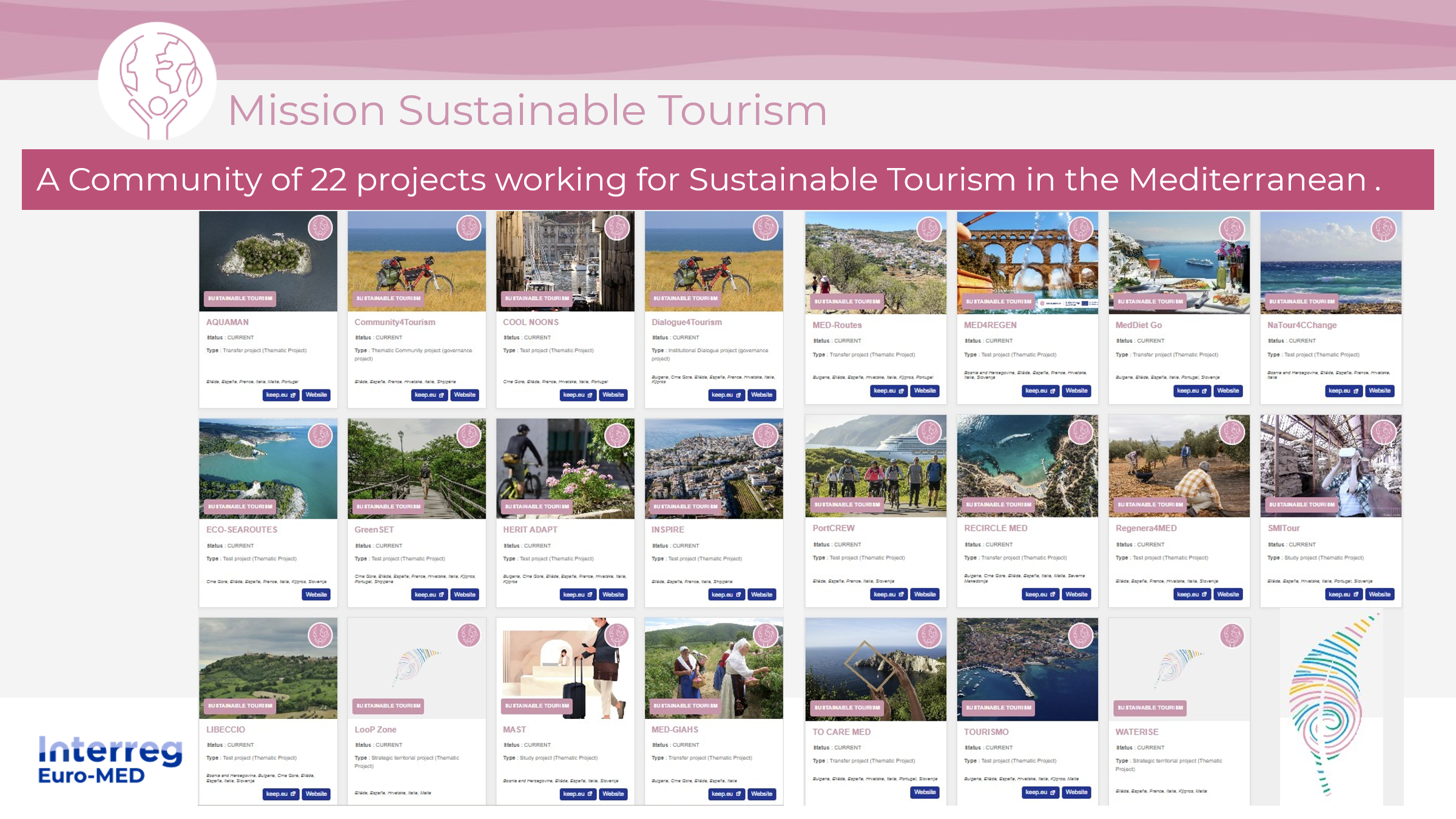
The White Papers presented by Ioannis Mardikis (European Public Law Organization, EPLO) and Gianni Chiannetta (Greening the Islands) showcased concrete results from Thematic Projects. The first -by Dialogue4Tourism Project with the support of the MED Cluster of Circular Economy of Community4Tourism Project- highlighted regional challenges and innovative solutions in circular tourism highlighting challenges of results of the Projects MAST, MED Routes, Green SET and Recircle MED; while the second -by Dialogue4Tourism Project with the support of the MED Cluster of Climate Change of Community4Tourism Project- emphasized small islands as hubs for climate resilience and sustainable practices, illustrating how project experiences can be transferred and applied in diverse Mediterranean contexts. Among the Thematic Projects shown here: NaTour4CChange, AQUAMAN, Water Rise, COOL NOONs and EcoSea Routes.
The event also was dedicated to the presentation of the Sustainable Tourism Policy Labs, implemented by (ASCAME, Association of the Mediterranean Chambers of Commerce and Industry, Spain), as a dynamic platform where lessons learned from projects are shared and co-created into actionable policies. This presentation was carried out by Luis Miranda, ASCAME.
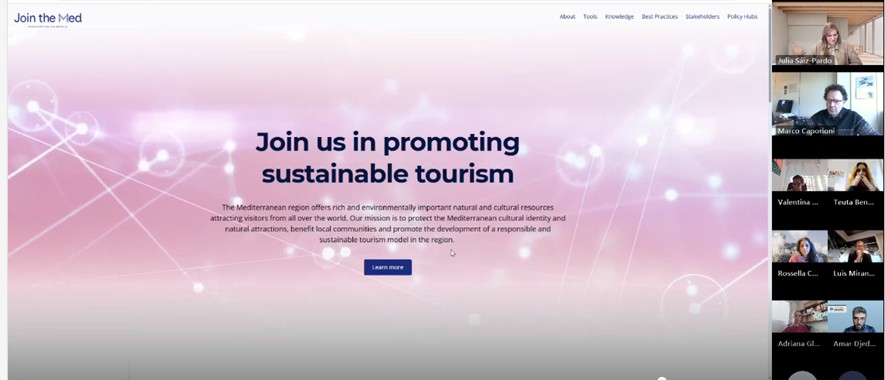
Participants explored the Join the MED Platform through a live demonstration by Dora Papatheochari (University of Thessaly Greece), enabling interactive access to tools, good practices, and knowledge for replication across the Euro-MED area.
The session concluded with an open discussion and Q&A, moderated by Kristina Brščić, encouraging participants to provide insights, share experiences, and propose ideas for the next Awareness event in 2026, continuing the cycle of knowledge transfer and collective action. In summary, the event showcased the impact of cross-project collaboration and the crucial role of sharing of best practices.