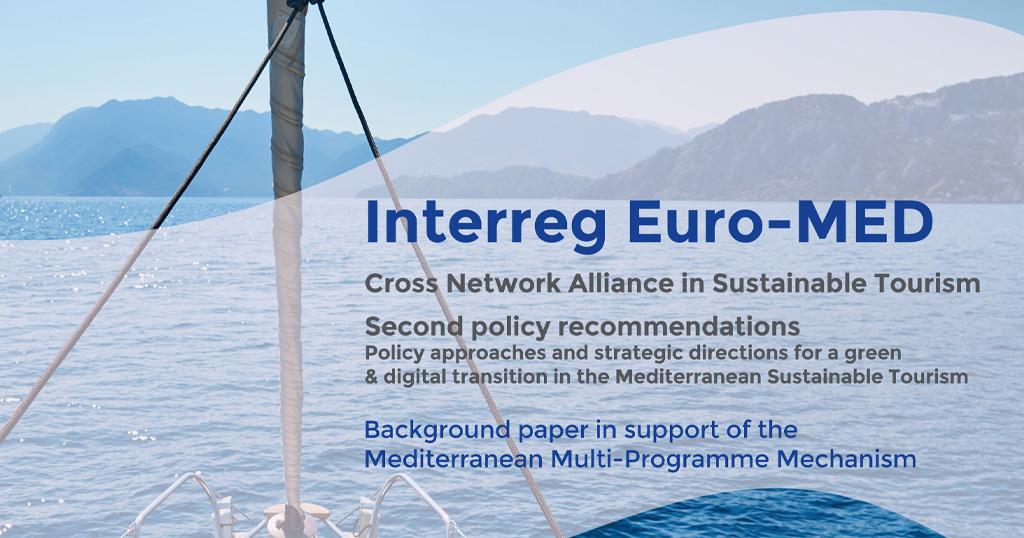

This Alliance is the key instrument of the Interreg Euro-MED Sustainable Tourism Mission to foster dialogue with other programmes, initiatives and strategies across the Mediterranean.
The Cross Network Alliance in Sustainable Tourism has published its second set of policy recommendations on sustainable tourism, developed within the framework of the Interreg Euro-MED Dialogue4Tourism Project. The document outlines strategic directions to support a green and digital transition across Mediterranean tourism systems.
The recommendations are the result of the Cross Network Alliance working group, held in the context of the Circle the MED Forum 2025 (Athens, Greece) organised by the partner of the Sustainable Tourism Mission EPLO (European Law Organisation). It brings together contributions from policymakers, researchers, financial institutions and international organizations, reflecting a broad, multi-level governance perspective.
This Alliance is the key instrument of the Interreg Euro-MED Sustainable Tourism Mission to foster dialogue with other programmes, initiatives and strategies across the Mediterranean. It supports cooperation and policy alignment in areas such as circular tourism, climate adaptation, digital innovation, sustainable mobility, blue economy development and inclusive economic transition.
Lessons from the Thematic Projects of the Interreg Euro-MED Sustainable Tourism Mission.
This set of recommendations recently launched highlight the experiences and results generated by the thematic projects of the Interreg Euro-MED Sustainable Tourism Mission demonstrating the value of territorial experimentation in addressing sustainability challenges in Mediterranean tourism. At the same time, remarks that the importance of these projects in tackling barriers related to policy uptake, coordination across governance levels and the scalability of pilot solutions. These findings underline the importance of strengthening mechanisms that allow project results to effectively inform policy development at regional, national and Mediterranean levels.
Feeding into the EU Strategy 2026
A key strength of these recommendations is their alignment with broader European processes. The text acts as a practical extension of the “White Paper on small islands as hubs for climate resilience,” recognizing these territories as innovation hubs for sustainability.
Furthermore, these guidelines are designed to feed directly into the upcoming EU Strategy for Tourism 2026. This ensures that the specific challenges of the Mediterranean—such as the skills gap— remain at the heart of the European legislative agenda.
In support of the Mediterranean Multi-Programme Mechanism
In this context, the Alliance also wants to feed into the discussion of the Mediterranean Multi-Programme Mechanism, by providing these recommendations that address the urgent, real-world complexities of the MED sustainable tourism landscape, including: Climate urgency by providing a structured basis for discussing adaptation strategies in the face of increasing environmental instability, balancing overtourism by offering data-backed frameworks to help the Mechanism navigate the tension between economic growth and the preservation of local heritage and digital and green synchronization by ensuring that the “twin transition” remains a central theme in inter-program discussions, aligning technological innovation with ecological goals.